Findings & Context
Positioning, findings, and open questions presented at ICEM 2026Co-authored with Lucrezia Bizzarri, Cristina Rossi, Alessandro Giannandrea, Maria Gabriella Buzzi, Mara D'Onofrio, and Claudia Maggiore.
For the full theoretical architecture and the Gemelli/Komen programme, see the Research page.
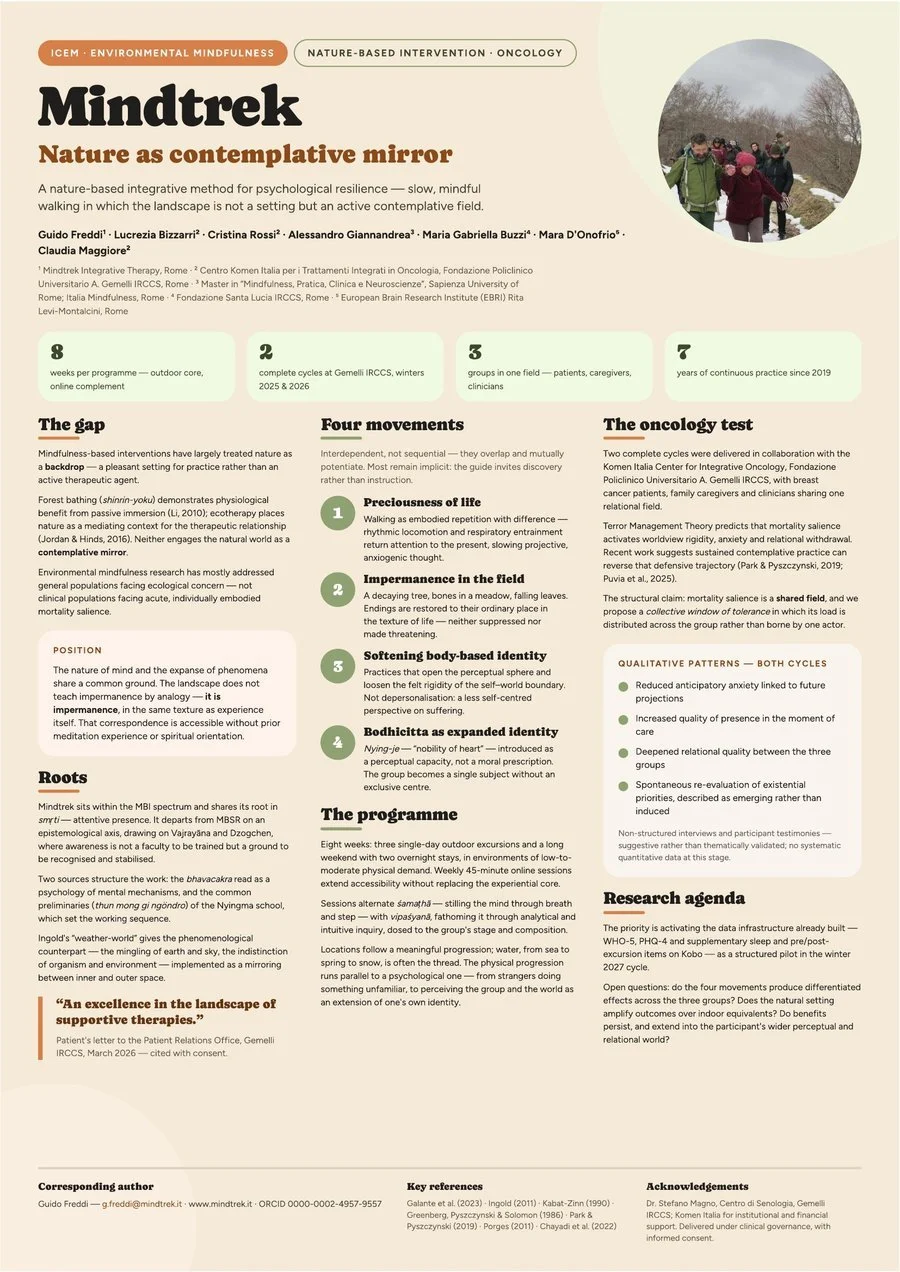
Qualitative patterns observed across both cycles
Reduced anticipatory anxiety linked to future projections
Increased quality of presence in the moment of care
Deepened relational quality between the three groups
Spontaneous re-evaluation of existential priorities, described as emerging rather than induced
These patterns are drawn from non-structured interviews and participant testimonies.
Research agenda
The priority is activating the data infrastructure already built — WHO-5, PHQ-4, and supplementary sleep and pre/post-excursion items on KoboToolbox — as a structured pilot in the winter 2027 cycle.
Open questions: do the four contemplative movements produce differentiated effects across the three participant groups? Does the natural setting amplify outcomes relative to an indoor equivalent? Do benefits persist and extend into participants' wider perceptual and relational world?
Key references
Galante et al. (2023) · Ingold (2011) · Kabat-Zinn (1990) · Greenberg, Pyszczynski & Solomon (1986) · Park & Pyszczynski (2019) · Porges (2011) · Chayadi et al. (2022)
Acknowledgements
Dr. Stefano Magno, Centro di Senologia, Gemelli IRCCS; Komen Italia for institutional and financial support. Delivered under clinical governance, with informed consent.